

Hjalmar Peterson
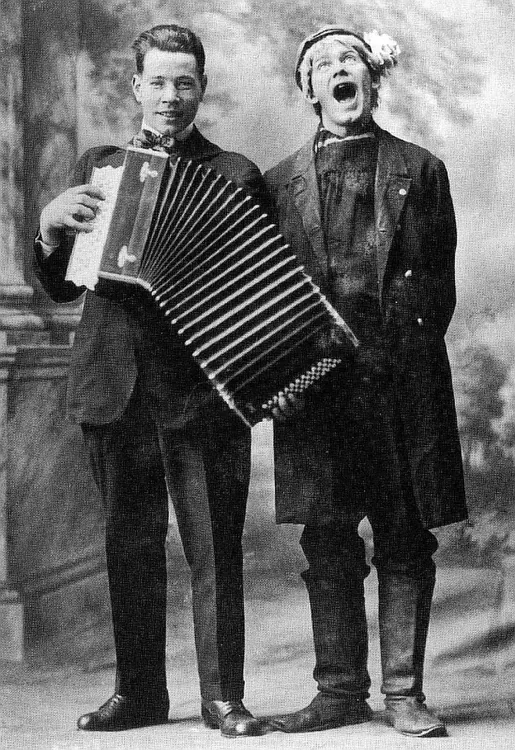
Hjalmar Peterson, born Karl Hjalmar Peterson on February 7, 1886, in Munkfors, Värmland, was a Swedish-American singer and comedian. He emigrated to the United States in 1905, initially working as a farmhand before gaining popularity performing at a farmers’ fair in Willmar, Minnesota in 1905. After a brief return to Sweden in 1909 for a six-month tour, he began touring the all-Scandinavian vaudeville circuit around 1910, establishing himself as a performer under the stage name Olle i Skratthult (Olle from Laughtersville). He initially worked as a bricklayer in the US and later settled in Minneapolis. As Olle, Peterson performed comedy utilizing the persona of a 'bondkomiker,' which is a Scandinavian type of rube comedian. This character was recognizable by a blacked-out tooth, a straw-colored wig, and farmer clothes. He built an orchestra and comedy company by 1916, and between 1916 and 1929, his orchestra recorded nearly four dozen records for Columbia and Victor. His performances included songs, dances, sketches, and monologues, often accompanied by a large band during the 1920s. He toured Sweden with Swedish-American quartets between 1909 and 1911. Notably, his recording of 'Nikolina' in 1917 sold 100,000 copies and is considered his best-known work; it tells a comedic story of courtship. Peterson also published songbooks with lyrics for audience participation and tall tales, including 'Olle i Skratthult, Nya Visor och Historier' in 1921 and 'Bland Kolingar och Kogubbar' in 1908. Peterson’s career experienced shifts throughout his life. He married Olga Lindgren, the company’s leading lady, in 1917, and they remained married until 1933. From 1914 to 1929, he recorded over 50 gramophone recordings. His popularity declined due to economic depression, reduced emigration, and pressure towards Americanization. He operated his own tavern and dance hall in Marquette, Michigan during the 1940s. Following a religious conversion in 1953, he joined the Salvation Army and continued performing as a soldier, channeling his vocal talents into Christian song. After his second wife, Mora Grace Engebretson’s death in 1949, his musical career ended permanently. He died on June 24, 1960, in Minneapolis. The Memories of Snoose Boulevard festival, held between 1972 and 1977, led to renewed appreciation for his music.