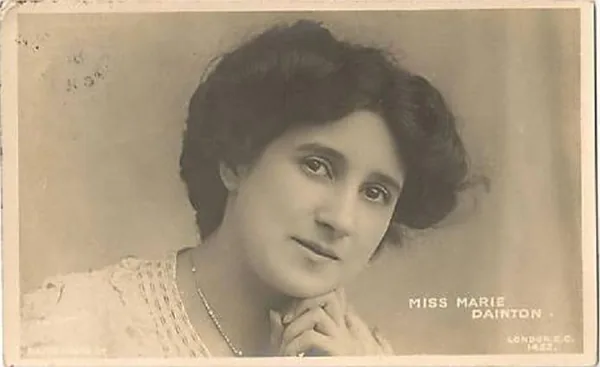
Marie Dainton was a British actress, vocalist, and mimic who entertained audiences from the late Victorian to the Edwardian eras. Born in Russia in 1881 and living until 1938, she established herself within the London music halls. Her stage career began on March 24, 1894, at York Theatre Royal, playing Little Red Riding Hood. Shortly after, she made her first appearance in London on August 6, 1894, at the Metropolitan music hall, quickly gaining recognition for her ability to imitate theatrical personalities; this became a defining characteristic of her performances. She toured extensively, including roles as Flo in Buttercup and Daisy in 1895 and as Fifi in The Belle of New York , which led to tours in Austria. Dainton’s comedy style centered on impersonations, relying on voice and manner rather than makeup. She was described as a “pretty impersonator of stage celebrities,” and her act included imitations of figures such as Maude Adams in What Every Woman Knows , Anna Held, Irene Franklin, Bert Williams, and Mrs. Leslie Carter. Around June 1899, she achieved significant success at the Avenue Theatre with Pot Pourri , further solidifying her reputation. Her performances often drew positive reviews; for example, The Indianapolis Star on November 23, 1909, praised her act as among the best of the season, noting she was not a sensational headliner. She also made gramophone recordings in 1902 for Gramophone & Typewriter Co Ltd and Pathé, including songs like "The à la Girl," "Sweet Little Sing-Sing," and "Mandie of Ohio." Dainton toured extensively, appearing in New York at the Casino Theatre (1900) and Apollo Theatre (1901), and again in 1909, performing vaudeville in New York and Indianapolis. Throughout her career, Dainton appeared in numerous productions. These included The House that Jack Built (December 1894), Puss in Boots (1898), A Chinese Honeymoon (1902) where she played Mrs. Pineapple, and Peggy Machree (1904). She also starred in plays such as The Girl Behind the Counter (1906) and was involved in the Music Hall War of 1907. Her later stage appearances included roles in Society Ltd (1920), Riverside Nights (1926), The Eternal Flame (1929), Getting George Married (1930), and The Werewolf (1932). Dainton’s performances were often part of larger vaudeville shows, sharing the stage with acts like Arthur Dunn and Marie Glasier performing “The Messenger Boy,” Witt’s “Girls From Melody Lane,” and Mr. and Mrs. Erwin Connelly's sketch "Sweethearts," as well as Winona Winters who performed songs, impersonations, and ventriloquism.