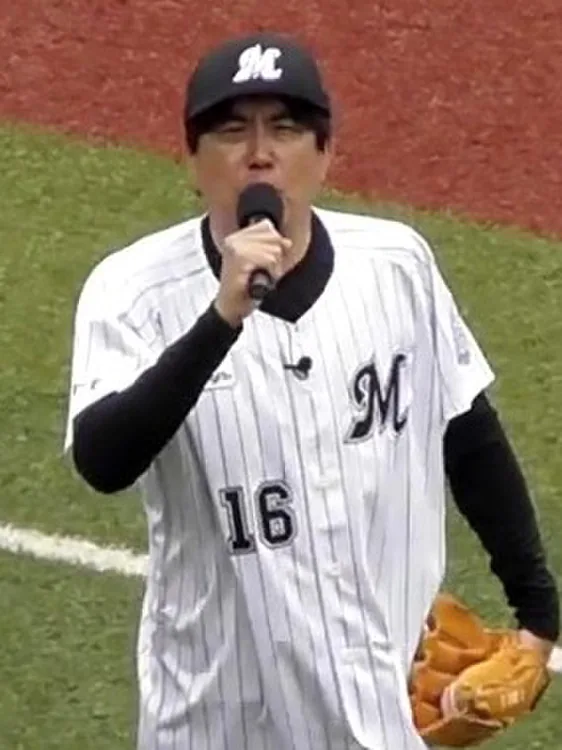
Takaaki Ishibashi
Takaaki Ishibashi, a Japanese entertainer who works as a comedian, singer and actor, rose to prominence as half of the comedy duo Tunnels and as a member of the group Yaen alongside Noritake Kinashi.
Tsutomu Sekine works in Japan as a comedian, singer and TV presenter. Earlier in his career he adopted the stage moniker Rabbit Sekine. He is managed by the agency Asai Kikaku. His daughter is the talent Mari Sekine.
Tetsuya Morita is a comedian, singer, YouTuber, guest, entrepreneur, and actor from Japan. In the comedy unit "Saraba Seishun no Hikari," he plays the roles of "Tsukkomi" (the straight man) and "Boke" (the funny man). He is originally from Kanaoka-cho, Kita-ku, Sakai City, Osaka Prefecture, and currently lives in Gotanda, Shinagawa-ku, Tokyo. He received a bachelor's degree from Osaka Prefectural Higashimozu High School after repeating a year. He is 164 centimeters tall, has a B blood type, and his stage name is the same as his real name. He serves as the chairman and CEO of The Morito Co., Ltd., and is active as an agent for Molk, and is also a certified Molk ambassador from the Japan Molk Association.
Boo Takagi performs comedy and music across Japan. He was given the birth name Tomonosuke Takagi. He also serves as a member of the troupe The Drifters.
Takeshi Kitano, also known as Beat Takeshi (born 北野 武), is a Japanese entertainer with a diverse career spanning comedy, acting, television, and film. He was born on January 18, 1947, in Itabashi Ward, Tokyo, and grew up in Adachi, Tokyo. His father, Kikujiro Kitano, was a painter, and his mother was named Saki Kitano. Kitano attended several schools including Umejima First Elementary School, Fourth Junior High School, and Tokyo Metropolitan Itabashi High School. He briefly studied mechanical engineering at Meiji University, but left at age 19. Before achieving fame, he held various jobs, including working as an elevator operator at the Asakusa France-za strip club, a candy seller, and a demolition worker. Kitano’s comedic journey began in earnest in 1973 when he formed the comedy duo Two Beat with Kiyoshi Kaneko (Beat Kiyoshi). Two Beat quickly gained popularity during the stand-up comedy boom of the early 1980s, recognized for their satirical and sharp-tongued black humor that often addressed social issues. They appeared on television programs such as THE MANZAI and Ore-tachi Hyōkinzoku . He is considered one of Japan’s “Comedy Big 3” alongside Hitoshi Matsushima and Tamori. Kitano also hosted the popular game show Takeshi's Castle from 1986 to 1990, which achieved a peak viewership rating of 24.7% and was later broadcast in the US as Most Extreme Elimination Challenge . Beyond comedy, Kitano transitioned into acting and directing. He appeared in Nagisa Ōshima's film Merry Christmas, Mr. Lawrence in 1983. He made his directorial debut in 1989 with Violent Cop , and continued to write and direct films. In 1997, he received the prestigious Golden Lion award at the Venice Film Festival for Hana-bi . Kitano completed his Outrage crime trilogy in October 2017 with Outrage Coda . Throughout his career, he has been recognized with numerous honors, including the French Order of Arts and Letters (Commandeur) in 2010, the Legion of Honour (Officer) in 2016, and the Order of the Rising Sun with Rays in 2018. He was married to Michi Nakamori from 1980 until their divorce in 2019.
Tony Tani, born Ōtani Shōtarō in Tokyo on October 14, 1917, was a Japanese entertainer primarily active in the 1950s. While his birthplace is disputed between Japanbridge Komachomachi and Ginza, he later attended Tokyo Prefectural Third Middle School in 1931 before dropping out in 1933. He served in the Imperial Japanese Army from 1938 to 1940. During the Allied occupation, Tani worked for occupying forces and the American Red Cross, managing shows and arranging Japanese entertainers. Tani gained popularity in the early 1950s as an emcee at jazz concerts. His stage persona was campy and high-energy, combining archaic language with catchphrases and pidgin English, often referred to as 'Tony English' or 'Tony-nglish'. He used androgynous eyeglasses, a pencil-thin mustache, slick suits, and a wig to create his distinctive appearance, and famously called himself 'Number One Handsome Boy'. His satire focused on American ideas concerning Japanese people, plus the effect of the U.S. occupation’s influence upon Japanese culture; jazz performances and mimicking American style were satirized by him. Tani’s unique style included using a soroban (Japanese abacus) as a rhythm instrument, lampooning Japan's post-war economic focus. He also used phrases like “saizan-su,” “okonba,” “katei no jijō,” and “bakka ja nakarō ka.” During the early 1950s, Tani experienced the height of his professional life, serving as a master of ceremonies for radio programs and in dance venues. From 1962, he gained wider recognition as the host of the television show 'Abeok Kyōgassen'. However, a significant change occurred in 1955 following the kidnapping of his eldest son, leading to a decline in his popularity. Social critics viewed him as a symbol of American ‘colonization’, and some audiences began to criticize his mocking style. Despite this, he attempted to revitalize his career in later years, resuming stage activities in 1986 planned by Yongu Sōsuke. In 1987, Eiichi Ohtaki produced the album This is Mr. Tony Tani , featuring his novelty musical recordings. Tani died on July 16, 1987, leaving behind a legacy that includes influencing manga creator Fujio Akatsuka, who based the character Iyami on him, and inspiring a character in a 2011 Pokémon episode.
Terence Lee, born Yoshiteru Katō (加藤善照), is a Japanese comedian. He portrays himself as a former mercenary, alleging that he was recruited for mercenary duties in the United Kingdom and that he operated as an unusually talented sniper.
Albania
1
Armenia
2
Argentina
36
Austria
27
Australia
52
Azerbaijan
1
Bangladesh
1
Belgium
13
Bulgaria
57
Benin
2
Bolivia
1
Brazil
27
Belarus
2
Canada
125
Democratic Republic of the Congo
3
Switzerland
17
Cote d'Ivoire
1
Chile
15
Cameroon
1
China
8
Colombia
4
Cuba
4
Czech Republic
7
Germany
188
Denmark
17
Dominican Republic
1
Algeria
2
Ecuador
2
Estonia
5
Egypt
10
Spain
74
Ethiopia
1
Finland
15
France
214
United Kingdom
365
Georgia
1
Ghana
3
Greece
18
Guatemala
1
Croatia
2
Haiti
1
Hungary
7
Indonesia
23
Ireland
31
Israel
10
India
47
Iraq
3
Iran
6
Iceland
4
Italy
136
Jamaica
1
Kenya
3
Korea, South
20
Kazakhstan
3
Lebanon
5
Sri Lanka
1
Lithuania
1
Latvia
1
Morocco
17
Myanmar
1
Malta
1
Malawi
2
Mexico
28
Malaysia
7
Nigeria
19
Nicaragua
2
Netherlands
2
Norway
12
Nepal
3
New Zealand
9
Peru
2
Philippines
35
Pakistan
7
Poland
8
Portugal
7
Qatar
1
Romania
1
Serbia
4
Russia
9
Saudi Arabia
4
Sweden
101
Singapore
3
Slovenia
4
Slovakia
2
El Salvador
1
Syria
1
Thailand
2
Tunisia
4
Turkey
5
Taiwan
1
Ukraine
11
Uganda
7
United States
213
Uruguay
4
Uzbekistan
1
Venezuela
5
Vietnam
1
South Africa
3
Zimbabwe
1
Japan has one of the world's most distinctive comedy cultures, with a wide range of performers working across television, stand-up-style comedy, manzai, conte, rakugo, film, theatre and digital entertainment. Japanese comedy, often referred to broadly as owarai, includes many different formats and performance traditions rather than relying on a single style.
Tokyo and Osaka are major centers of Japanese comedy, with Osaka particularly associated with the country's manzai tradition. Television comedy shows and variety programs have also played a major role in making comedians familiar to audiences throughout Japan.
Japan has produced many comedians who have become major television and entertainment personalities. Well-known names associated with Japanese comedy include Takeshi Kitano, Hitoshi Matsumoto, Sanma Akashiya, Tamori, Shinsuke Shimada, Downtown, Cocorico, Sandwichman and Audrey.
Japanese comedians often work as part of comedy duos or groups rather than performing exclusively as solo stand-up comedians. Some have also become television presenters, actors, filmmakers, writers and producers, making comedy an important part of Japan's broader entertainment industry.
A newer generation of performers has also built audiences through YouTube, streaming platforms, podcasts and social media, adding new formats to Japan's established comedy traditions.
Japanese comedy includes several distinct forms. Manzai is a two-person performance in which comedians typically play contrasting roles, with one performer delivering setups and the other responding with jokes, corrections or rapid-fire comments. Conte is closer to sketch comedy, using characters and situations to create humorous stories.
Another traditional form is rakugo, in which a solo performer tells a humorous story while seated, using changes in voice and expression to portray different characters. These traditions exist alongside contemporary television comedy, improvisation and other forms of live performance.
Japanese comedians often explore everyday situations, relationships, social behavior, work and cultural observations. Wordplay, timing, exaggerated reactions and carefully developed comic characters can be important elements of performances.
Television is central to Japanese comedy culture. Variety programs frequently feature comedians alongside actors, musicians and other entertainers, while comedy competitions and special programs provide opportunities for performers to gain national recognition.
Japan also has a strong live comedy infrastructure, particularly in Tokyo and Osaka. Comedy theatres and entertainment venues provide spaces for established acts as well as performers developing their material.
Digital platforms have added another dimension to the scene. YouTube, streaming services and social media allow Japanese comedians and comedy groups to reach audiences directly and experiment with formats outside traditional television.
Whether you're interested in Japanese comedians, manzai performers, comedy duos, traditional rakugo or contemporary Japanese comedy, Japan offers a remarkably varied collection of styles and personalities.
Browse GiggleTime to discover comedians from Japan, learn more about individual performers and explore Japanese comedy alongside comedians from countries around the world.